Steps toward acquiring a bioptic driver’s license in Ontario
Blog vol 5.51. Steps toward acquiring a bioptic driver’s license in Ontario
Back in 2020, when we optometrists were celebrating our year (20/20:), and a tiny virus was spreading through the known world, the Ontario government made it possible for visually impaired individuals to drive with telescope assistance. Life altering for many. Who knew that a lightly circulated blog on the inter-webs would reach hundreds of people (yes, that's this blog!), providing hope for a more normal, independent life.
Fast forward five years. The Ontario government is figuring it out. As with any new legislation, the devil is in the details. It is one thing to change five words in an existing piece of legislation and it is another to make it a functional reality.
This is you: you are visually impaired and you have never met or no longer meet the visual requirements for driving in Ontario. There is hope, even though it is involved, it is doable, so here it goes…
Step 1. Contact our office at icare@burlingtoneye.ca or call (905) 639-9595. Describe your situation and arrange a “low vision” assessment, a longer, much more involved appointment. There is a fee for this assessment.
Step 2. You make the trip to Beautiful Burlington, with your trusted family and any visual aids and relevant information about your situation.
Step 3. The good doctor does a low vision assessment which focuses on your visual impairments and your visual capabilities in light of your unique life, vocational, and academic needs.
Step 4. Your main question is driving so we focus on that task. The failure to meet Ontario driving standards may be a visual field problem from glaucoma or a stroke. It may the result of macular degeneration that has advanced in your senior years or it may be a condition like albinism which you were born with and you have worked with all your life.
Step 5. If you qualify, you can apply to the Vision Waiver Program, which assesses your capability to drive with a field restriction. Each claim with the Ministry of Transport is scrutinized and, if allowed, you can have your driving assessed to determine eligibility for a license. This is without bioptic assistance.
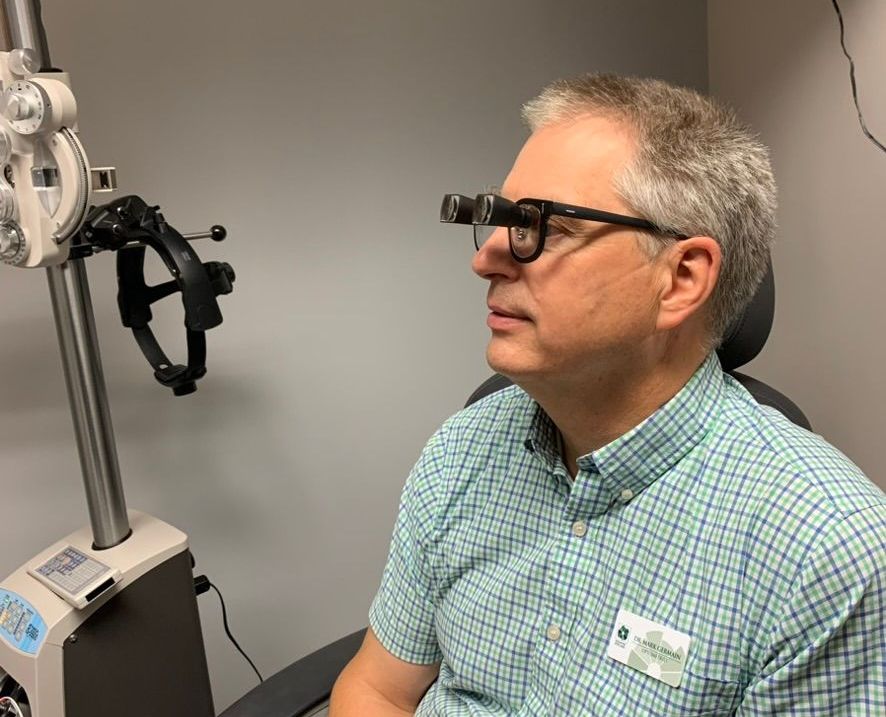
Step 6. If your field of vision meets the Ministry’s guidelines, then the door is open for using a bioptic. The bioptic is a telescope that is fitted in the top part of your glasses and when looking through it must get your visual acuity to at least a 20/50 in order to drive. The telescope cannot be more than 4X power and must have a fixed focus. You also should have a contrast acuity of at least 1.30 to help with mobility and a visual acuity of 20/150 or better.
Step 7. You meet all these criteria and now you can be fitted for a telescope. Your glasses prescription is incorporated into the telescope to maximize your vision. You are measured for the bioptic and then it is ordered. There is government financial assistance aid through the ADP program to help with the cost of the device.
Step 8. The government is notified of your intention to pursue a bioptic license and the custom glasses arrive a month later, are fitted, and you are trained in tracking and spotting with the telescope, first sitting then later moving about.
Step 9. You go home with the bioptic and you practice, sitting in the passenger side of the car, walking in your neighbourhood, and watching television. Practice, practice, practice.
Step 10. After three months of practice you return to us and we review the use of the telescope and check the fit and then send the final letter to the ministry to ask for an assessment for driving which must be done in Barrie.
Step 11. The driving assessment involves use of the telescope and driving with it on. Pretty nerve racking; further training is often required to pass. Finally you pass!!! A special license with a bioptic restriction is awarded and you can drive. Every year after that, you must have your vision assessed. The annual assessment is also required for those in the waiver program.
There you have it. It can be done, and we have a good number of licensed bioptic drivers that have come through our doors. We will see you again next year. We also welcome all those who think they might benefit from this special world of bioptics.
Til next week,
The good doctor