It all started at Wellington Square
Blog vol 5.46. It all started at Wellington Square.
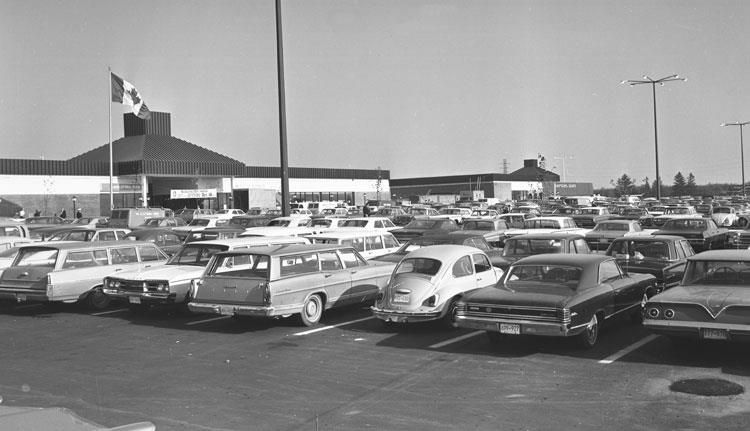
The book, Vanished Burlington by Gary Evans, describes the early days of Burlington. As we at Burlington Eyecare approach our 60th anniversary celebrations, we look back to Burlington 60 years ago. In 1964, the area bordered by Brant and John Street on the East and West and by James and Pine on the North and South was developed into a modern new mall for downtown Burlington. It was called Wellington Square Mall. (see below, this was state of the art!)
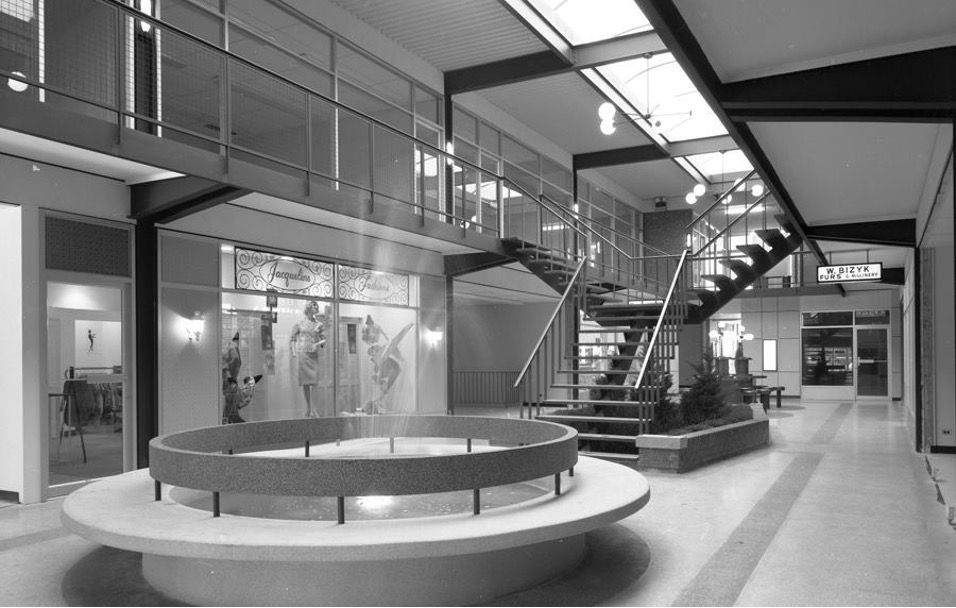
Dr. Ronald Watson, who was practicing with Dr. D.B. Freeman at 490 Brant Street in 1964, decided to step into the future and set up an office in the upper concourse of this new, swankified locale. He practiced successfully there for ten years, but space was at a premium and he needed to take on a new associate. Dr. Watson went east. The town of Burlington had recently expanded out that way with the opening of the Burlington Mall in October, 1968 with large anchor stores Simpson Sears and Dominion. All your shopping needs in one convenient, climate-controlled location AND free parking! The downtown area of Burlington has always been short of parking, and with the latest condo developments (one of which will sit on the same spot as the original Wellington Square Mall), that will continue to be a pressing problem. In 1975, Dr. Watson made the move to 3400 Fairview, purchasing the building with Christopher Breen LL.B..
Dr. Watson attended the School of Optometry when it was in Toronto on St. George Street, graduating in 1962. That same year, the school moved to Waterloo and became part of the University of Waterloo. In 1975 Dr. Nancy Wilson joined the practice. In 1975, Dr. Wilson, who was from Listowel, Ontario, graduated from Waterloo, made the move to Burlington, and met her future husband, Peter Shaver (of the Shaver Pharmacy family business on Brant Street). The practice thrived, with both doctors active in their profession: Dr. Watson taught Optometry at Waterloo and became a Fellow of the American Academy of Optometry, and Dr. Wilson specialized in the new field of contact lenses.
In 1987 I, Dr. Germain, graduated from Waterloo in optometry, actually “walking” across the stage at the same ceremony as Dr. Watson. The School of Optometry in Waterloo granted degrees retroactively to all the graduates from the Toronto School on that same afternoon. In 2002, after a time teaching Optometry in St. Louis, Missouri, and working with Dr. Watson, he asked me to join his practice. I liked it so much, I bought it from him. Generously, Dr. Watson stayed on for two more years to ease the transition. For the next eight years Dr. Wilson and I worked together, and we were still growing. I purchased Skinner Opticians of Hamilton (started in 1949 by Gordon Skinner on John Street North) and in 2007, moved it to Burlington, along with some exceptional staff members. Dr. Wilson retired in 2010 and we made the painful move into the 21st Century installing electronic medical records, a bear of a thing to change. In the meantime, we had taken up more and more space in the building at 3400 Fairview and were busting out at the seams.
With the help from people like Val Haslam, Roger Sales, and others in the industry, we put our heads together and designed a new office to help meet the coming challenges. In November of 2014 we moved, in three days, across the street to our current address at 3235 Fairview. More space, more parking, and room to grow. Since then we have taken on new associates, Dr. Lesley Epstein (who after 6 years moved to Kingston with her family), then Dr. Jerilee Nyman (who was sadly taken from us by breast cancer in 2022), and I am glad to say, we now have Dr. Krystal Chee (since 2018), Dr. Ryan Cavaliere (since 2020), and Dr. Maya Vujicic (since May, 2025!).
Looking back, you see the “humble” beginnings of a local Burlingtonite who committed himself to providing excellent eye care to the people of Burlington. With the support of wonderful associates and staff, this service becomes possible. A special thank you to all that have done great work and those who continue to do great work at Burlington Eyecare. You are what makes it happen.
To commemorate 60 years, we are having a celebration this Saturday from 1-3 pm, with food and live music and fun. All invited.
‘til next week,
the good doctor