Combining myopia treatments may be the best option
Blog vol 4.52. Combining myopia treatments may be the best option.


The latest study in Eye, the official journal of the Royal College of Ophthalmologists, shows the advantage of combining therapies for myopia, especially in older children. This is great news, especially if the eye doctor needs to get a little more leverage on the myopia. We have known for some time that single therapies such as atropine drops, orthokeratology lenses, or defocus lenses in spectacles or soft contacts each help to significantly reduce myopia development.


Knowing that each of these treatments works in different ways, it has been theorized that a combination could be even more effective. The retrospective study by Tang et al. (see here) has shown the effectiveness of putting atropine drops and orthokeratology lenses together. The atropine drops are used once nightly in each eye and the corrective glasses or contacts are worn as prescribed. 


As a parent, all you need to do is bring your child for a regular eye exam and we will measure the axial lengths of your child’s eyes, and then track their progress. Early intervention is always best and regular monitoring allows the best results.  We see children as early as six months, but myopia treatments are not necessary until at least 5 or 6 years. It is good to watch how your child’s eyes develop over time to see if the changes as they grow are trending toward myopia.


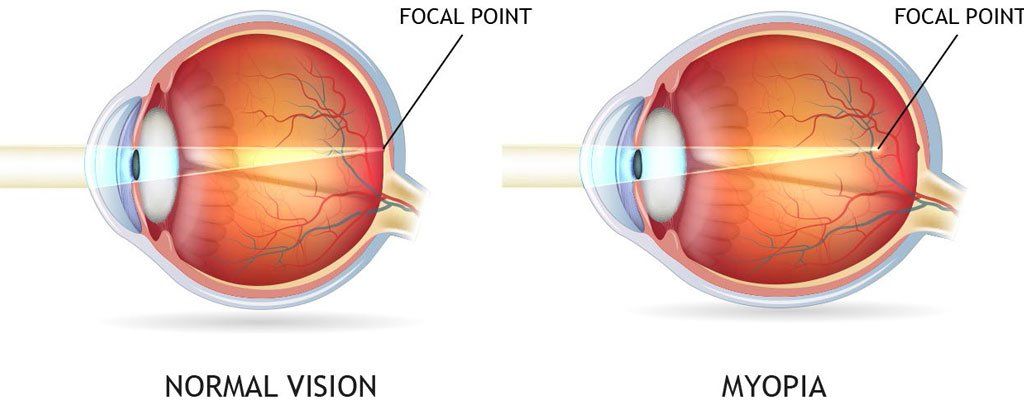
Now, myopia is not the end of the world and if your child has never had their eyes examined you have not done them terrible harm. You are not a bad parent. Myopia (near-sightedness) is on the rise in many parts of the world in a really really significant way. This increase of myopia and the severity of that myopia can be linked to the time we spend on near-work, such as screens and studying, from a young age. Of course, myopia can be corrected by glasses and contacts or laser surgery. So why the fuss?  Myopia, especially high myopia, significantly increases the risk of other eye problems. If it can be kept under control at the start, wonderful. 


An aside, and a step further back, I strongly suggest to parents, as a preventative measure and to ensure your child’s overall health, that you seriously consider screen time management and, when possible, encourage outdoor play. Time outdoors has the added benefit of building distance vision, an excellent myopia prevention.


SUMMARY FOR PARENTS


FIRST: SCREEN TIME MANAGEMENT.

SECOND: OUTDOOR PLAY.

THIRD: ANNUAL EYE EXAM.


In spite of our best efforts, myopia still happens. With this study confirming our practical experience, we are primed to mix and match treatments. Myopia management requires personalized care taking into account age of onset, rate of progression, and lifestyle. If you want the best results, combo therapies appear to be the way to go.


Til next week,


The good doctor



By Dr. Mark Germain May 1, 2026
The good doctor discusses how the eye is a window to the heart with the help of the OCT.
The good doctor take a deeper look at how gut health is connected to eye tissues.
By Dr. Mark Germain April 29, 2026
Blog vol 6.40. The Gut and the Eyes. One of my biggest jobs is to keep abreast of new research and advances in eye health. Most recently, we have seen new stem cell research, gene therapies, as well as new drugs for dry and wet macular degeneration. In January of this year, there was an article in the journal, Cell Death and Disease, that looked at cell apoptosis, specifically with the photoreceptors of the eye. (Read the article here ). Apoptosis is the genetic programming of deliberate and constructive cell death, allowing for the maintenance of healthy structures and systems in the body. Some estimates have the body replacing 50 to 70 billion cells daily by this process. Necrosis, on the other hand, is unplanned cell death caused by injury, toxins, or other negative outside factors; this causes inflammation and disrupts the body’s balance of things. There are stressors that speed up cell turnover. The study looked at photoreceptors in the retina and were able to demonstrate cellular recovery, even in late stages of apoptosis, recovery not breakdown. When certain stressors were reduced, by working with the mitochondria, there was recovery of the photoreceptor cells. How? Mitophagy, the mitochondria’s own process of programmed breaking down and then repurposing the recycled components for new ones. This mitochondrial repair helps to reverse the sequence of apoptosis for the photoreceptors. Mitochondria, how cool. How is this helpful for our eyes? Conditions like retinitis pigmentosa or macular degeneration directly involve the photoreceptors and may be slowed or reversed by helping the mitochondria. So, let’s take care of those mitochondria. There is some evidence for nutritional support for the mitochondrial system. The nutrient, Urolithin A (UA), which is a compound made in our gut from fiber found in pomegranates, berries, and nuts is the only clinically proven substance known to trigger mitophagy, made in the gut no less. Vitamin B3 is critical for mitochondria function, however vitamin B3 based supplements are still to be clinically tested for their support of cell recovery. Nutrients Coenzyme Q10 and L-carnitine are known to help the mitochondria generate energy, and interestingly, infrared light therapy has also been shown to benefit mitochondrial function. Again, food for thought. The gut and its function needs a lot of research. How do probiotics and nutrient precursors affect eye tissues? It is so interesting that the gut can be a factor in eye health. Maybe adding Urolithin A as a supplement is wise, along with the antioxidants in Lutein and Zeaxanthin we use to combat photoreceptor degeneration. Will keep you posted on any new developments.  The good doctor
By Dr. Mark Germain April 16, 2026
The good doctor focuses in on visual processing. Why do we miss things that are right in front of our eyes?
By Dr. Mark Germain April 10, 2026
The good doctor discusses the Artemis II mission, space travels affects on the eyes, and "the dark side of the moon"
By Dr. Mark Germain April 3, 2026
The good doctor discusses exciting new and emerging options to treat nystagmus.
By Dr. Mark Germain March 27, 2026
The good doctor reflects on The Country of the Blind, a book by Andrew Leland which gives insight into the experience of vision loss.
More Posts