the good doctor on: the OCT

Blog # Twelve, the Crazy, Hazy, Days of Summer,

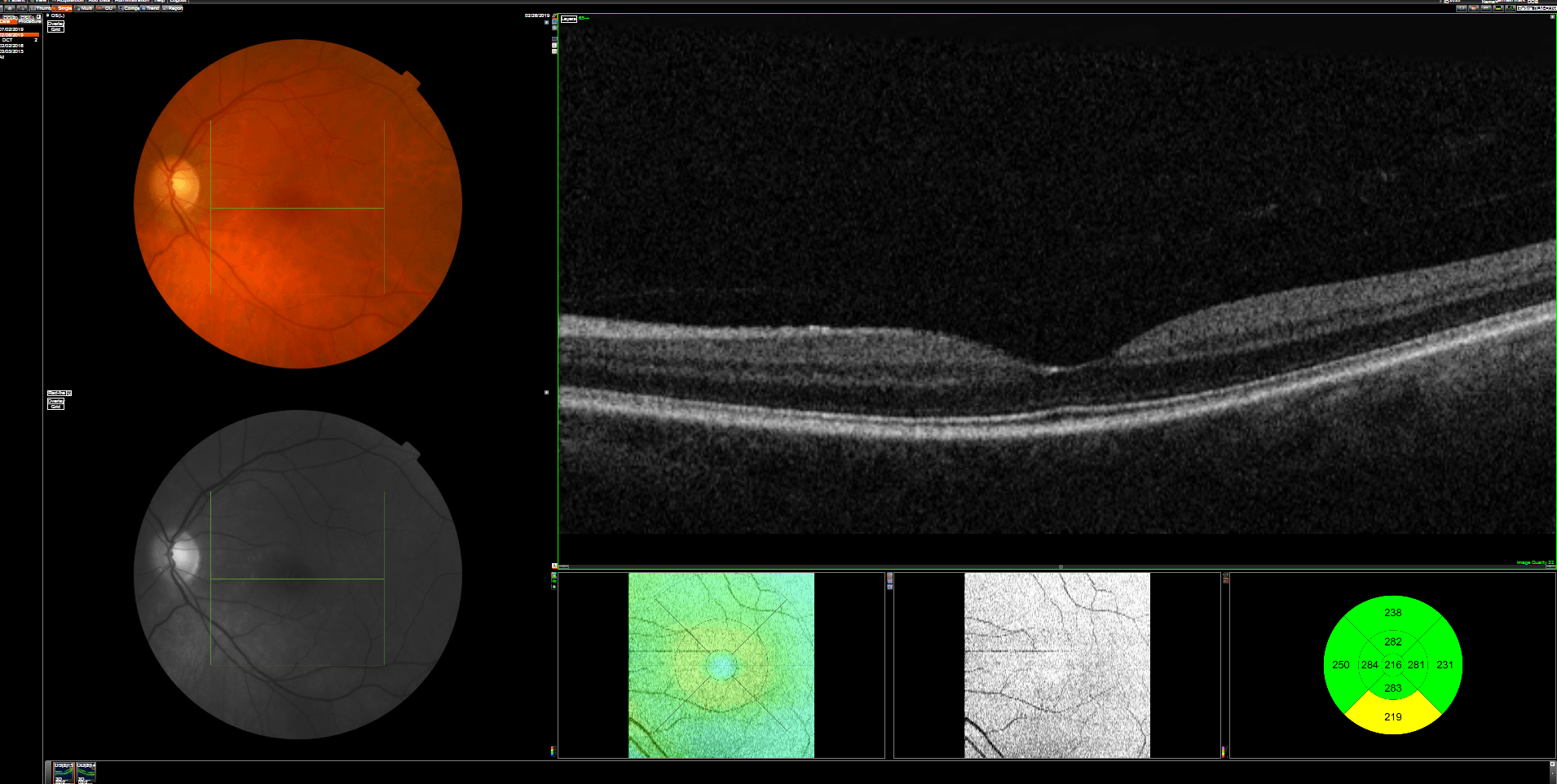
We are in the middle of a heat wave, all the more reason to talk about infrared again. Last week we looked at the uses of infrared, especially at Burlington Eyecare. Infrared sensors are sensitive to heat; night-time security cameras have infrared sensors so we can pick up movement even in dark conditions. I would like to spend more time on the optical coherence tomographer, the OCT, which uses infrared to allow us to see with incredible clarity and detail the inside of your eye. It really is a very exciting tool which has just kept getting better over the past 15 years.

The OCT is a critical part of our eye examinations performed on all our patients that are over 19 years of age. It allows us to detect changes in the retina early, and provide appropriate intervention early, which of course makes the prognosis better. In the summer of 2019 we updated to the latest edition of OCT and our old work horse was shipped to Ghana, Africa to help Medical Mission International.

This new machine, the OCTA, (A for angiography) has opened even more doors for us, enabling us to be able to measure the front of the eye and pick up narrow angles for glaucoma and give more accurate fittings for scleral contact lenses. The angiography package maps blood flow in the choroid, helping us to detect eye conditions that occur because of lack of oxygen. It enables us to help our patients with macular degeneration, which is the number one cause of vision loss in the western world. With regular monitoring and with timely angiography scans we can help patients if their condition worsens and get them where they need to go for timely treatment. As you can see, we are pretty high on this new technology.

The picture you see is a profile of the retina in side view that we obtain with the OCT, a healthy retina actually looks like a book in side profile lying on a desk. Those layers you see are actually layers of cells in the back of the eye. Cool!

Keep cool and stay safe, til next week,

The Good Doctor, Dr. Mark Germain, Burlington Optometrist

By Dr. Mark Germain May 1, 2026
The good doctor discusses how the eye is a window to the heart with the help of the OCT.
The good doctor take a deeper look at how gut health is connected to eye tissues.
By Dr. Mark Germain April 29, 2026
Blog vol 6.40. The Gut and the Eyes. One of my biggest jobs is to keep abreast of new research and advances in eye health. Most recently, we have seen new stem cell research, gene therapies, as well as new drugs for dry and wet macular degeneration. In January of this year, there was an article in the journal, Cell Death and Disease, that looked at cell apoptosis, specifically with the photoreceptors of the eye. (Read the article here ). Apoptosis is the genetic programming of deliberate and constructive cell death, allowing for the maintenance of healthy structures and systems in the body. Some estimates have the body replacing 50 to 70 billion cells daily by this process. Necrosis, on the other hand, is unplanned cell death caused by injury, toxins, or other negative outside factors; this causes inflammation and disrupts the body’s balance of things. There are stressors that speed up cell turnover. The study looked at photoreceptors in the retina and were able to demonstrate cellular recovery, even in late stages of apoptosis, recovery not breakdown. When certain stressors were reduced, by working with the mitochondria, there was recovery of the photoreceptor cells. How? Mitophagy, the mitochondria’s own process of programmed breaking down and then repurposing the recycled components for new ones. This mitochondrial repair helps to reverse the sequence of apoptosis for the photoreceptors. Mitochondria, how cool. How is this helpful for our eyes? Conditions like retinitis pigmentosa or macular degeneration directly involve the photoreceptors and may be slowed or reversed by helping the mitochondria. So, let’s take care of those mitochondria. There is some evidence for nutritional support for the mitochondrial system. The nutrient, Urolithin A (UA), which is a compound made in our gut from fiber found in pomegranates, berries, and nuts is the only clinically proven substance known to trigger mitophagy, made in the gut no less. Vitamin B3 is critical for mitochondria function, however vitamin B3 based supplements are still to be clinically tested for their support of cell recovery. Nutrients Coenzyme Q10 and L-carnitine are known to help the mitochondria generate energy, and interestingly, infrared light therapy has also been shown to benefit mitochondrial function. Again, food for thought. The gut and its function needs a lot of research. How do probiotics and nutrient precursors affect eye tissues? It is so interesting that the gut can be a factor in eye health. Maybe adding Urolithin A as a supplement is wise, along with the antioxidants in Lutein and Zeaxanthin we use to combat photoreceptor degeneration. Will keep you posted on any new developments.  The good doctor
By Dr. Mark Germain April 16, 2026
The good doctor focuses in on visual processing. Why do we miss things that are right in front of our eyes?
By Dr. Mark Germain April 10, 2026
The good doctor discusses the Artemis II mission, space travels affects on the eyes, and "the dark side of the moon"
By Dr. Mark Germain April 3, 2026
The good doctor discusses exciting new and emerging options to treat nystagmus.
By Dr. Mark Germain March 27, 2026
The good doctor reflects on The Country of the Blind, a book by Andrew Leland which gives insight into the experience of vision loss.
More Posts