A year of books

Blog vol 3. 31. A year of books


This is my last blog for 2022. Good vision and seeing clearly is critical for reading. So many of my patients are readers and we have some great conversations about books, so I thought I would do a little reminiscing about the books that I read this year.


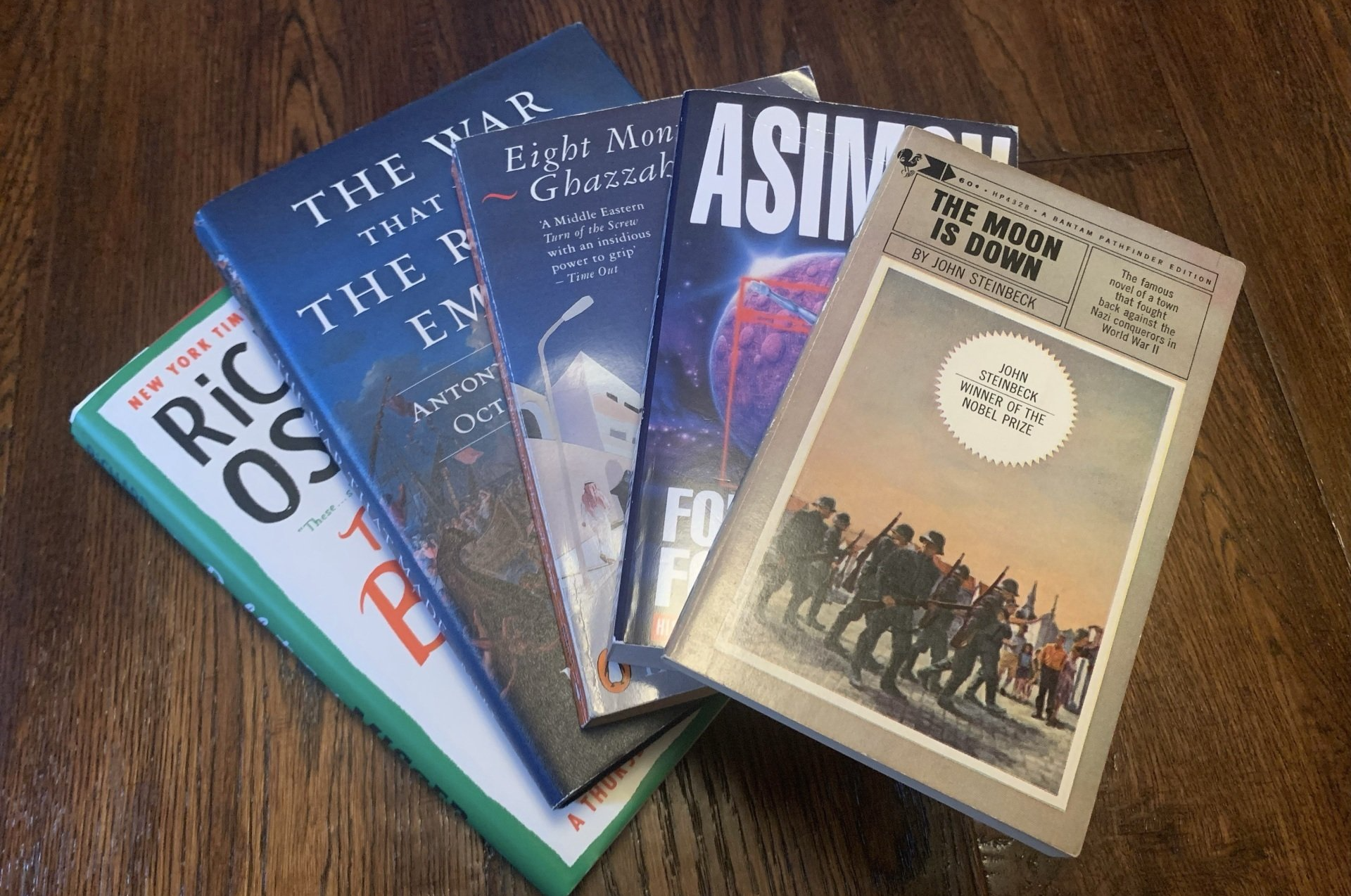
A really good series is from the pen of a British author, Richard Osman. It is called The Thursday Murder Club, and it is about a group of seniors who meet every Thursday to solve cold and not-so-cold murder cases. His love for humanity and the quirkiness of the main characters is really endearing. Please do not get on the wrong side of these “gentle” geriatric folk, for you will rue the day you did. There are three books in the series thus far, and I would read them in order. I am eagerly looking forward to his next release.


A science fiction series that came out in the 1950s called the Foundation was originally three books but the author, Isaac Asimov, wrote two prequels that follow the life of Harry Seldon and his final days (it also is quite autobiographical). These two did not disappoint; I always wanted to know more about this genius who could mathematically “predict” what the future would be. The whole series is a great testimony to Asimov’s breadth of knowledge and his understanding of history, politics, culture, and, of course, robots. I have yet to touch on his other many sci-fi stories and I cannot wait to delve in.


I also read two of John Steinbeck’s shorter works: Of Mice and Men and The Moon is Down. The first is about two migrant field workers, George and Lennie, during the Depression. Steinbeck does a great job of depicting the struggles of finding work and of having dreams and shooting for them. The Moon is Down I found fitting during a war between Ukraine and Russia as it is set during the Nazi occupation of WW II, where a village is trying to resist its occupiers.  The main character tells the Nazi officer that they will not be able to hold their gains, the villagers will eventually prevail, really prescient in times of conflict (and over and over again).


The literary world was saddened by the death of Hilary Mantel in 2022. Her trilogy on the life of Thomas Cromwell was brilliant, a must-read for anyone interested in history, and also a well-written story. She wrote a book in 1988, Eight Months on Ghazzah Street, which is an insightful observation, from a Londoner’s perspective, of the Saudi regime and all its complexities. It is about a British engineer and his wife who work in Arabia and is based on the author’s real-life experience. 


My final book is a history by Barry Strauss called The War that Made the Roman Empire. It is about the rise of Octavius after the death of Julius and describes the main players and the political and military manoeuvres that led up to and prevailed in the Battle of Actium. Strauss does a masterful job highlighting the main characters, especially Octavius, and his naval commander, Marcus Agrippa. When I first read this book I was not aware of all the intricacies involved or of how capable Octavius was at politics or the crucial importance of Agrippa’s leadership. I have other works by Strauss to read and eagerly await his next book.


These were some of my favorite reads from 2022. Would love to hear yours.  


All of us at Burlington Eyecare wish all of you a very Merry Christmas and all the best for the New Year.       


til next year,


the good doctor


By Dr. Mark Germain May 1, 2026
The good doctor discusses how the eye is a window to the heart with the help of the OCT.
The good doctor take a deeper look at how gut health is connected to eye tissues.
By Dr. Mark Germain April 29, 2026
Blog vol 6.40. The Gut and the Eyes. One of my biggest jobs is to keep abreast of new research and advances in eye health. Most recently, we have seen new stem cell research, gene therapies, as well as new drugs for dry and wet macular degeneration. In January of this year, there was an article in the journal, Cell Death and Disease, that looked at cell apoptosis, specifically with the photoreceptors of the eye. (Read the article here ). Apoptosis is the genetic programming of deliberate and constructive cell death, allowing for the maintenance of healthy structures and systems in the body. Some estimates have the body replacing 50 to 70 billion cells daily by this process. Necrosis, on the other hand, is unplanned cell death caused by injury, toxins, or other negative outside factors; this causes inflammation and disrupts the body’s balance of things. There are stressors that speed up cell turnover. The study looked at photoreceptors in the retina and were able to demonstrate cellular recovery, even in late stages of apoptosis, recovery not breakdown. When certain stressors were reduced, by working with the mitochondria, there was recovery of the photoreceptor cells. How? Mitophagy, the mitochondria’s own process of programmed breaking down and then repurposing the recycled components for new ones. This mitochondrial repair helps to reverse the sequence of apoptosis for the photoreceptors. Mitochondria, how cool. How is this helpful for our eyes? Conditions like retinitis pigmentosa or macular degeneration directly involve the photoreceptors and may be slowed or reversed by helping the mitochondria. So, let’s take care of those mitochondria. There is some evidence for nutritional support for the mitochondrial system. The nutrient, Urolithin A (UA), which is a compound made in our gut from fiber found in pomegranates, berries, and nuts is the only clinically proven substance known to trigger mitophagy, made in the gut no less. Vitamin B3 is critical for mitochondria function, however vitamin B3 based supplements are still to be clinically tested for their support of cell recovery. Nutrients Coenzyme Q10 and L-carnitine are known to help the mitochondria generate energy, and interestingly, infrared light therapy has also been shown to benefit mitochondrial function. Again, food for thought. The gut and its function needs a lot of research. How do probiotics and nutrient precursors affect eye tissues? It is so interesting that the gut can be a factor in eye health. Maybe adding Urolithin A as a supplement is wise, along with the antioxidants in Lutein and Zeaxanthin we use to combat photoreceptor degeneration. Will keep you posted on any new developments.  The good doctor
By Dr. Mark Germain April 16, 2026
The good doctor focuses in on visual processing. Why do we miss things that are right in front of our eyes?
By Dr. Mark Germain April 10, 2026
The good doctor discusses the Artemis II mission, space travels affects on the eyes, and "the dark side of the moon"
By Dr. Mark Germain April 3, 2026
The good doctor discusses exciting new and emerging options to treat nystagmus.
By Dr. Mark Germain March 27, 2026
The good doctor reflects on The Country of the Blind, a book by Andrew Leland which gives insight into the experience of vision loss.
More Posts