Shifting Colours and Textures: the Octopus
Blog vol 6.26. Shifting Colours and Textures: the Octopus
A blog about light… colours… texture… how we see, perceive.
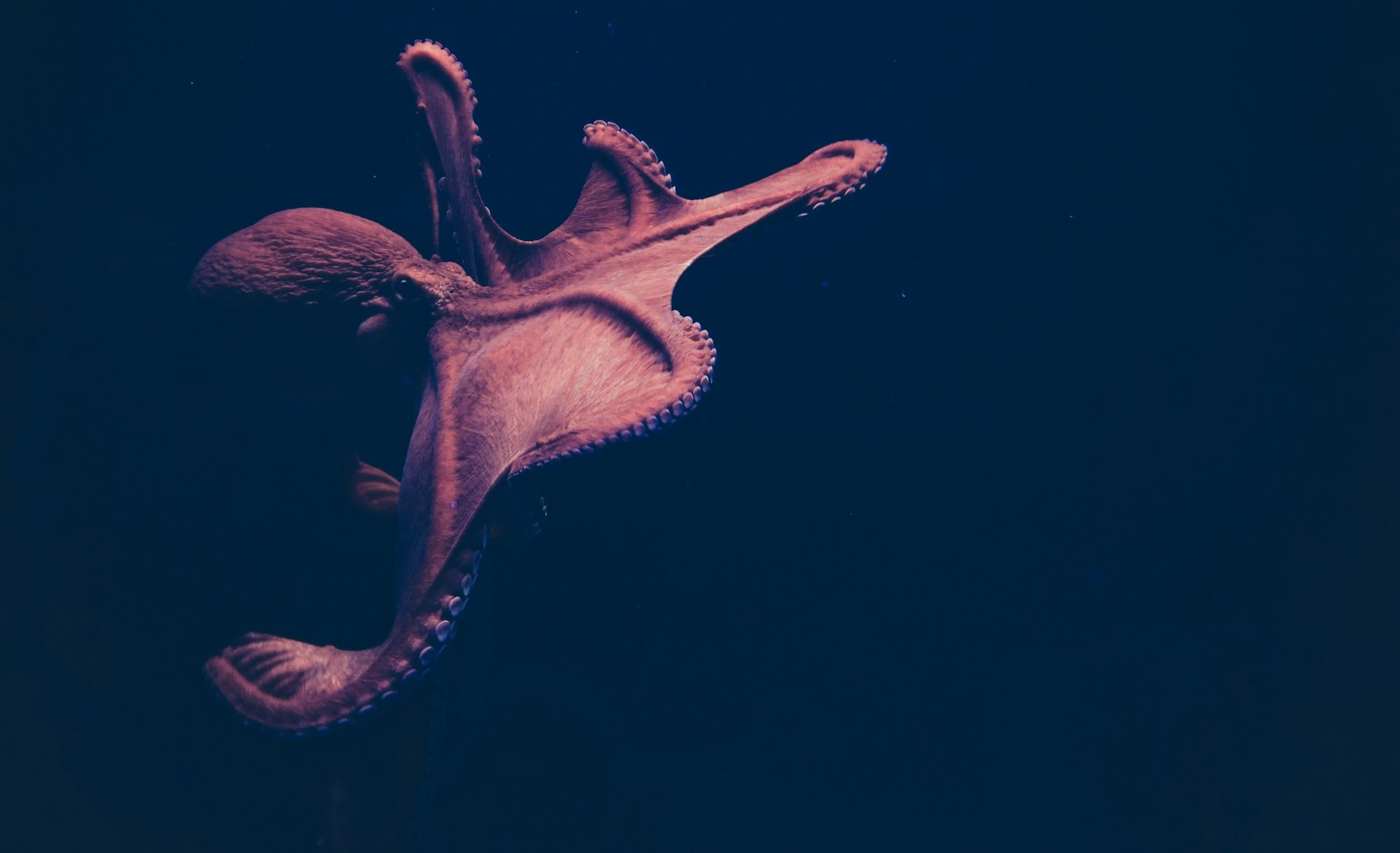
Last weekend my son and his friends spent a day at Ripley’s Aquarium in Toronto. If you have not gone, drop everything and go, well worth the trip to Toronto. When I go, I always look for the elusive octopus, a fascinating creature.
Masters of camouflage, they can change their colour, texture, and shape to hide in any environment. Think of the “septopus” (missing one tentacle), Hank, in Finding Dory. Very funny.
How do they do this?
1. Chromophores - octopi have thousands of these tiny sacs that are pigment filled. By stretching or shrinking them, their colour changes.
2. Iridophores - these are tiny cells that act like mirrors to reflect colours and are dependant on the viewing angle.
3. Leucophores - also reflect light but are not viewing angle dependant. They scatter reflecting light to spread it out (this is why polar bears are white: they have leucophores in their fur which spread out the full spectrum light).
4. Papillae - bumps on their skin that can be raised or lowered to create different textures.
Stanford researchers are reporting a major advance: a flexible material that swells into new textures and colours within seconds, forming patterns with details even finer than the human hair. Dr. Doshi et al. came up with this material almost by accident. They were using an electron microscope to examine nanostructures that they had created on a polymer film. The used samples are usually discarded, but on this occasion, the researchers decided to reuse them. To their surprise, they found that the regions of the film that had been previously imaged with electrons were behaving differently and turned a different colour.
Good science requires excellent observation skills and openness to discovering new paths and ways, like Edward Jenner and his observations on cowpox in dairy workers to help develop the small pox vaccine, or Alexander Fleming observing that mold (accidentally planted) on a petri dish culture impeded bacteria growth when he was studying influenza, ultimately leading to the discovery of penicillin.
Back to the Stanford lab. The researchers were able to finely control the electron beams, the polymer, and the amount of water on the layers to create very fine images on the substrate. The colour and even texture of the substrate can be changed by controlling these factors. Read more from Stanford here.
Some fine tuning and we can have “skins” that will blend right in! This concept can also be of use in nanotechnology for changing the texture and the amount of friction in several fluid applications. One door leads to another, and so on…
Keep your eyes open, remember we all are scientists and need to pay attention, ask questions, and think.
The good doctor